
A fellow therapist and friend who is also navigating big grief, shared with me that a friend of hers in Savannah says when someone dies there, the friends put a black wreath on their front door and keep it there for three months to let the world know that this person is grieving. The community takes care of everything for them so that they can grieve and cry, bringing them food every day for three months.
She followed up with the commentary of how grieving is aloud to be messy and for her, even hearing about the black wreath ritual felt validating in comparison to her grief experience, that feels more like “an aggressive non-validation, almost a crazy making, gaslighting, how muted our grief is.”
I burst into tears when I read her words, feeling validated too. I definitely try to stay buttoned up and act “normal” for other people, not wanting to make anyone feel uncomfortable, fearful of being judged, or trying to be solved like an equation. But grief cannot be solved and there is nothing pathological or wrong with grieving, however that looks like for you. Grief doesn’t have a set amount of time and it is different for everyone, but no matter the amount of time, you are not going to be the person you used to be. You will be different and that is natural.
What a special ritual for those who live in her friend’s Savannah community. They are allowed to be different, to be messy, to be however they need to be, it is understood, grief is encouraged. Unfortunately, for many (most?) of us, we grieve alone and we are expected to get over it quickly. Our culture does not know how to handle griefs myriad of feelings, waves, and phases. Our culture does not understand that grief needs ritual and tending and love and community.
Aside for my sister visiting the day after my father passed for the first couple of days, I have been grieving in solitude. And I felt compelled to share how I am navigating that. You are not alone in how alone you feel. You don’t have to be literally alone to feel alone either. You can be partnered or surrounded by people and still feel unseen, unsafe, or emotionally distant with partners, friends, and family. So when I speak of being alone, I speak of how you feel and not the literal circumstances.
Every day I take the time to connect with my mom and my dad on the other side. I take the time to connect with my spirit team and with the goddess. It is my daily morning ritual. I do this by lighting a candle every morning and pulling a few tarot cards. Sometimes I write. Sometimes I journey. Sometimes I sit in silence and listen. But I start every morning connecting to the other side. Reminding myself that I am never alone in that sense. I say my morning invocation and that plugs me into the transpersonal. I speak to my parents, spirit guides, my soul, body and my inner child. I honestly cannot imagine going even one day without my morning ritual. I do what feels natural to me as there are many ways to connect spiritually.
When a wave of grief tears hit, I let it out. Of course that feels cozy and safe when I’m by myself and can ugly wail and cry but if a grief storm hits and I’m on the street or in a public place, I let it out anyway. I let myself look like a weirdo. I tell myself the grief storm is here and I surrender to it completely, allowing the storm to pass through and cleanse my soul. I trust grief. And I know that a grief storm will have its way with me and leave as quickly as it came on.
If grief shows up as a depression wave, I take myself out to eat delicious food and let myself overdo it. I will also overdo binge watching shows. Or I will light a candle, make a drink and stare out the window while listening to music. Sometimes getting outside into nature helps. During a depression wave I try not to listen to my thoughts. I try not to identify with my low mood that feels like dial tone, exhaustion or a low pressure storm. Sometimes I get caught in the spiderwebs of my thoughts and feelings, which causes me to needlessly suffer and it takes some work to get back out. That’s OK too. Sometimes you fall into the abyss. I find the best medicine during a depression wave is pleasure of the senses. Just like the grief storm the grief depression will leave as quickly as it settles in.
When I start to get overwhelmed with how alone I feel, when the desperation hits hard and I feel starved for human connection, I invoke and ask my spirit team to fill me with love. I’ll talk to my mother and father out loud. Or I’ll make a post to connect with the collective. The desperation wave will leave in its own time just like the other grief waves. I have learned to not expect others to be here for me, but also not to shame myself for wanting them to be here for me.
Without my father, I feel like the root has been severed within. Sometimes grief feels like being lost, like I am floating in space with no tether. It feels scary, unfamiliar, bewildering. How can I be in this world without him? How lost and rootless I feel without him causes me to feel embarrassed too. Like a child who cannot be in this world without her papa. But that’s a judgement, so I toss it out and I remind myself that it’s OK to feel embarrassed. I may need to talk to my inner child and remind her that it’s not shameful to still need him even as an adult.
The secret key is learning how to surrender and feel every grief wave without judgment, without identifying yourself with the feeling, and learning that every wave will seize you completely and then leave as quickly as it came on. Grief is like the ocean, ebbing and flowing in its waves, sometimes mellow, sometimes turbulent and stormy, always mysterious and vast. Grief is much bigger than you and it knows what it is doing. Our culture is a big vast thing that largely does not know what it is doing with grief.
I rely upon my spirit team. Always have. In my current grief, I call upon my spirit team to fill me with love and support. I visualize the severed root repairing itself with light. I remind myself that I am becoming the diamond through pressure. I am growing a new root. Death transforms. Through grief, a magical alchemy of the self occurs, if you allow it. Death is medicine, even the most tragic death is compost for the soul. This does not cancel out the horror, injustice, wrongness, and unfairness of tragic death. The transformative alchemy of death (in any form) sits right beside the terrible pain of loss. Both/and.
When grief hits like a wave of deep longing, I start talking to my dad or my mother. And if I’m still and quiet, I will hear them respond. We all have the ability to talk to our loved ones on the other side. They will talk back to you and it will sound like your own thoughts. You can learn to feel the difference between your own thought and a loved one putting a thought in your head. It’s subtle. But if you cultivate the art of sitting in silence and stillness, you can begin to feel the difference. Communicating with my mother and father brings me immense joy.
My ego, just like anybody else else’s ego, wants out of the discomfort of grief, wants it to be over, wants to move on, wants a new goal, wants the new chapter to begin. But grief takes time. And in the liminal space between the old and the new chapter, I find micro joy to be the way. Appreciating the tiniest moments grounds me in truth. Embracing simplicity keeps me centered. Keeps my nervous system regulated. A simple walk in nature. A yummy drink or meal. The beauty of candlelight, a sunset, light through colored glass. The way one comfortable moment feels. Connecting with a friend. Listening to to the birds. Feeling a good stretch. You get the idea. Micro joys feel like stringing Christmas lights around a massive grief tree, bringing warmth and ambience to the heavy journey.
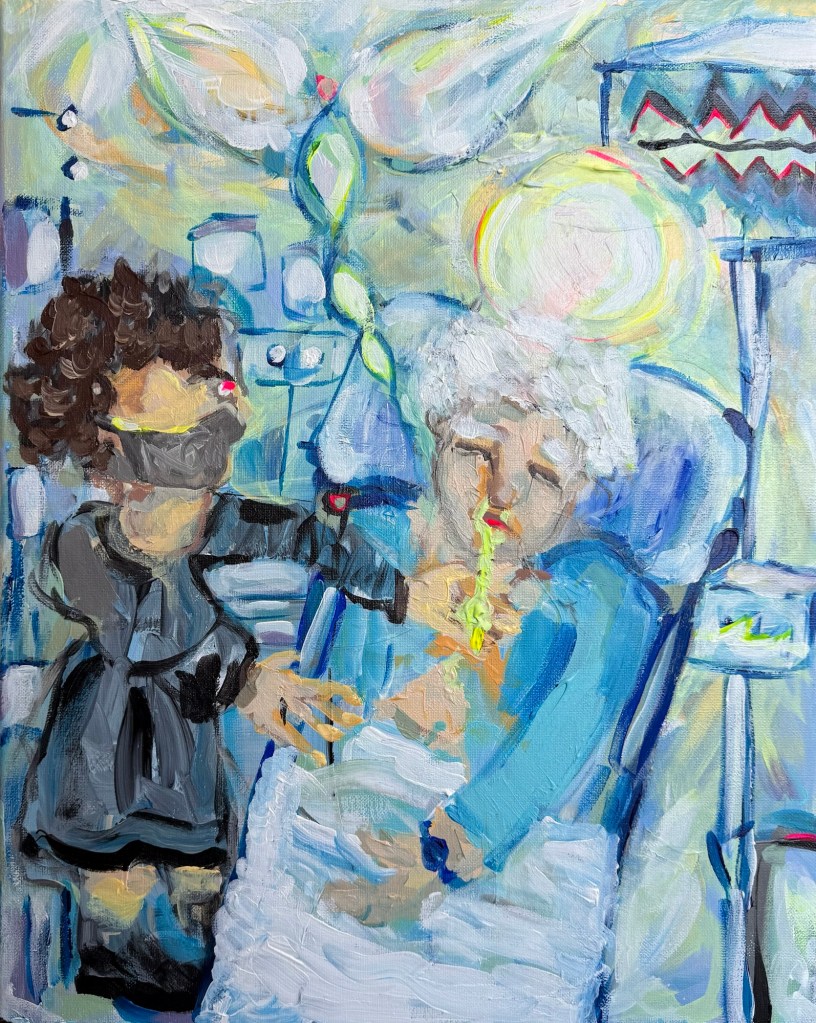
Creative expression is one of the strongest medicines on my grief journey. I have written about the story of my dad‘s death day about ten times already, in ten different ways. Sharing the story with friends who are interested also feels deeply healing and still has a creative element about it because every time I tell the story it is different. For me, grief is a soulful experience. And there is nothing more soulful than creative expression. I painted the moment my father died in the heat of grief, one day after my father died. I am still processing his death day and painting it felt like honoring the moment. A moment I went through alone with him. A beautiful moment that I treasure, that tore me apart and that sits in my heart like a jewel.
There are a variety of grief groups if you feel called in that direction. Process groups, creative groups, groups that eat meals together, and groups that go deep. I am not drawn in that direction myself but I wanted to mention it. Feeling alone is not something to solve. Our culture tries hard to solve uncomfortable feelings. In my grief journey, I am learning how to embrace uncomfortable feelings, embrace the aloneness of grief versus trying to solve it and get comfortable again. Embracing the aloneness of grief is transforming me. Death transforms. But that is for another blog.
 Bloom Counseling